


Castles of scotland

Updated: Jun 24, 2025
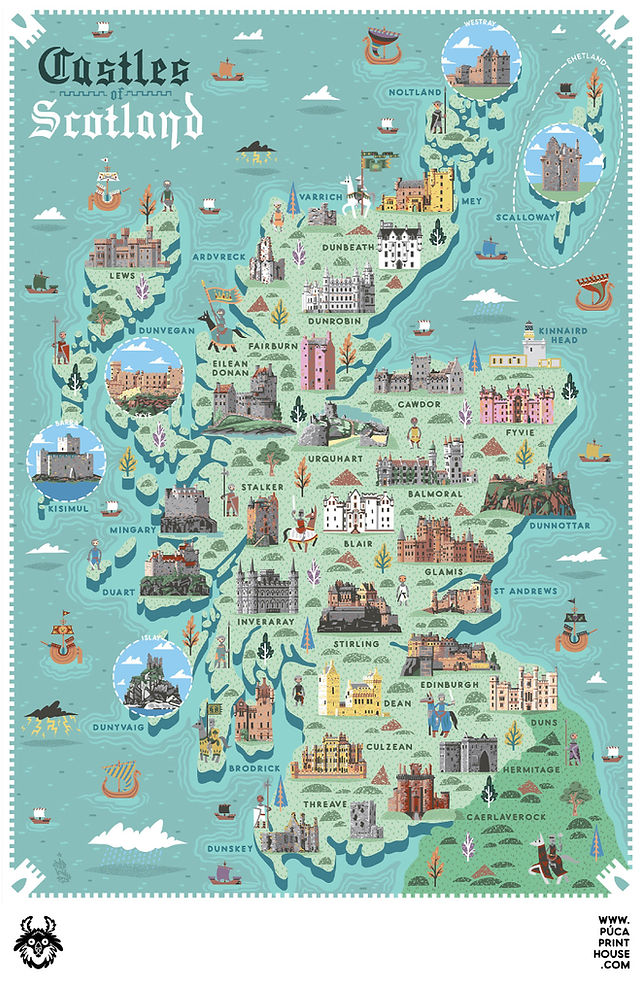


I can't believe it's been 2 years since we moved to Bonnie Scotland, and it's high time to celebrate that with a second Scotland map. It has taken a lot of willpower to work on other maps in the interim.
The maps started as a way to find interesting areas to get out and see, and this does just that for me; hopefully, it will for you too. I am certainly at the age where my idea of a good day out is loading the family into the car and heading off to see a castle, picking up a magnet from the gift shop, and preferably eating something tasty (dadbods require maintenance, you think ALL THIS just happens, no no no, darling, this requires effort). Look, I'm nearly 40, and notions of being a rockstar have long since dissipated into healthier and more realistic goals; if I get to look at some cool old stuff and eat some chippies, I'm a pretty happy camper.
So let's have a look at some of the wonderful castles of Scotland. As usual, I will state that the following are simply little nuggets of information I find interesting. Writing the entire history of a castle as part of a blog is folly (unintentional castle pun?) and not the goal. If you want to know more about any of the castles, I am sure you can find a whole wide world of literature both online and in analogue.
As ever, thanks to everyone who has supported the project! You guys are awesome, and we couldn't keep it going without you! If you would like to support us, the maps and other goodies are available in our store, or you could buy us a coffee, alternatively, you could share us (with links).
We appreciate you greatly.
Update- I’m working on book proposals at the moment, so I’ve kept some stories offline to save them for the books (and to stop anyone pinching all the hard work before they’re published!). If you’d like to know when the books are ready, just pop your name on the mailing list.
In the meantime, here are a few of my favourite castles, typically ones with folklore attached-
Caerlaverock
“Mighty was Caerlaverock Castle. Siege it feared not.”
It probably should have though, to be fair. In its history, it was besieged several times and, during its siege by old Longshanks, we have one of the best documents of a siege - known as 'the Roll of Caerlaverock.' The document describes the two-day siege where 60 men tried to hold the castle against an army of over 3000, siege weaponry, and 80-100 knights (I've read varied amounts, still a lot of heraldry flapping around in the wind). Eventually, they were forced to submit.
The Roll claims, 'life and limb the good king spared, and gave each a garment new,' however, other sources claim the men were hanged from the side of the castle. Knowing Edward's general MO of brutality and being an all-around massive horror show of a man, I know which I believe to be most likely. I don't think a man known as the 'Hammer of the Scots' was likely to say, 'good job lads, here's some new gear.'
Brutal history aside, Caerlaverock is an awe-inspiring castle. It has a uniquely triangular design, although there is another one in Pisa, Italy. The gatehouse is truly impressive, and it also has a moat and some wonderful stone carving on the interior. It is amazingly intact for a 13th-century castle that has endured such a violent history.
Due to its bloody history, it is said to have its own resident Red-cap. For those who don't follow our mythical beasts offerings, a Red-cap is a type of murderous goblin found in border lore, known for soaking its hat in the blood of its victims. Gory history aside, or maybe because of it, Caerlaverock is a great place to visit and one of my favourite Scottish castles. They have many great events in the summer months.
Cawdor
"All hail, Macbeth! Hail to thee, Thane of Glamis!"
"All hail, Macbeth! Hail to thee, Thane of Cawdor!"
"All hail, Macbeth, that shalt be king hereafter!"
Cawdor Castle is linked to one of Shakespeare's most famous plays, 'Macbeth.' The only problem lies in the fact that the castle didn't exist for another four centuries after the eponymous king of the Scots, Macbethad mac Findláech.
Fortunately, a real Thane of Cawdor, William Calder, who built the castle, comes with a fun legend himself. It is said Cawdor Castle's location was chosen not for any logical strategic reason or its resources; this would be far too simple. No, this decision came from where all the most reliable and sensible ideas originate: a dream.
The Thane had a dream that told him to load a donkey with the gold required to build the new castle, and wherever it lay down to rest, that is where he should build it. Apparently, this is what happens when you have 14th-century 'screw you money'; you are wealthy enough to just strap gold to a beast of burden and say 'meh, let's see how this plays out.' I will not be selecting any real estate by slapping a debit card on a Dachshund and developing wherever it lays down to lick its butt.
Fortunately, the donkey didn't just keel over at the end of the street or choose to call it a day in some boggy ditch somewhere, but rested conveniently in a lovely spot next to a holly tree. The castle was built around the tree, and though long dead, you can still see the remains of it within the castle.
Culzean
Though what we see of Culzean these days is largely an 18th-century mansion, it was developed around an earlier 14th-century tower. It is one of Scotland's most visited castles and is eye-catching in its bold design by famous architect Robert Adam. The castle was given to the National Trust with the exception of an apartment on the top floor which was to be gifted to Dwight Eisenhower, who stayed there 4 times, once whilst president of the USA.
Today Culzean is a vast estate, with gorgeous surroundings, collections and possibly the best playground I have ever seen.
Culzean castle has a couple of wonderful bits of folklore surrounding it too which makes it particularly interesting to us.
The first is a very common phantom piper motif. Culzean Castle is built atop a cave network, and one day, in a quest to find out where they lead, a piper was sent in to wander them. As usual in these tales, the sound abruptly stops and now the site is haunted by a phantom piper, which I imagine is one of the more invasive types of haunting when you're trying to kick back and watch some telly.
The second tale tells of some fairy lore at Culzean. The laird was walking the grounds when a young boy appeared with an empty wooden mug requesting some ale to help his sick mother. Being a kind chap he sent him to find his chief servant to fill his cup from his private reserve. The young lad found the servant, who begrudgingly obliged his laird's wishes.
As the ale flowed, the cup never seemed to fill, the keg ran empty, and still the cup remained dry. The servant said he would not pour another drop, he recognised Fairy magic when he saw it. The laird turned up and said a promise is a promise, a single drop from the freshly tapped keg was all it took for the cup to fill.
Years later, the Laird was away fighting a war when he was captured and tied up in a dungeon awaiting execution. Who should turn up but the young lad, not aged a day. He ordered the laird to climb on his back, and flew him home to Culzean Castle. Confused, the laird asked why he had done this, the lad said simply that one good turn deserves another.
Oh, and I should mention, Culzean was also used as the home of Lord Summerisle in the seminal film "The Wicker Man" - one of our favourites and celebrating its 50th birthday this year.
Dean
Okay, so I'm going to get pretty soppy here for Dean Castle. I visited it this summer, and it blew my mind.
The castle has been massively restored and looks amazing. It really is a sight to behold. Standing in the courtyard, looking at the beautiful intact walkways, and up at the impressive tower, it felt so "real". Seeing such old features made new, as it would have looked, was a rare treat. The castle interior is also beautiful. Seeing the halls hung with banners, walking onto the bard's mezzanine, and hearing music of the time being played made the place come alive.
A bit of disclosure, I previously worked as an 'audience and community engagement officer' for the Heritage Lottery Fund, where we would look at how heritage buildings could work with the communities they butted up against and become a valuable community asset. And, well, Dean Castle smashes it. I would hold it up as an example when other people are looking for comparator visits, etc. It is situated just next to a large residential area, and is owned by the council. As a result, it is FREE, it is free to visit the castle, country park, and farm. It also has a very affordable cafe, which is to be commended. I'm unsure of their community outreach program, but I did notice some posters up for events, and I dare say, based on how well they are doing everything else, that they're probably smashing this too.
I write this while drinking from a Dean Castle enamel mug. 4
Dunvegan
Dunvegan Castle is a pretty satisfying castle to look at; it has a definite castley quality to it, like it could be made with old-school Lego, before they brought in all the jazzy bits. It's one of Scotland's oldest castles, with the tower dating back to the 14th century, but having a curtain wall on site from the 13th.
One of the things that interests me about Dunvegan, and the reason I had encountered it long before making the castle map, is that while researching the 'Mythical Beasts of Scotland' map, I came across a strange artefact held at Dunvegan Castle. Now, the Isle of Skye is ripe with fairy mythology, and may be one of the most famous areas on the planet for fairy lore, but here, to my knowledge, is something unique: The fairy flag.
There are a few stories relating to the origins of the mysterious flag still displayed at Dunvegan. They split into 2 camps:
1- It was acquired in the Crusades by an earlier member of the family, namely Harald Hardrada, who is an ancestor to Clan MacLeod. Though when this theory was explained to Reginald MacLeod while having the flag preserved at the V&A, he replied, 'Mr. Wace, you may believe that, but I know that it was given to my ancestor by the fairies.' Mr. Wace diplomatically and gentlemanly simply said, 'Sir Reginald, I bow to your superior knowledge,' and I just love that whole interaction.
2- Fairies gave them it. And if Mr. Wace wasn't going to argue it with the MacLeods, I - a person who has drawn the fairies of Skye - will not be arguing it either.
The first story tells of a chief's son who, when put to bed one night, kicked off his blankets; the fairies, not wanting him to get cold, placed the blanket over him. When he woke up and was brought into the room with his family, a fairy choir could be heard singing melodious songs.
The second fairy story tells us of a MacLeod chief who married a fairy. For a year and a day, they were together until she had to return to her land. She gifted him the fairy flag and told him that if he ever waved it in battle, no matter the odds, he would win, but be careful; you can only use it 3 times. The flag has only been waved twice until now, and it did deliver victory. A rumour has it that Dame Flora offered to wave it at the white cliffs of Dover to repel the German invasion. So rest easy, countrymen; no matter how bad it gets, we've always got 1 wave of the fairy flag left.
Fairburn
"The day will come when the Mackenzies of Fairburn shall lose their entire possessions … Their castle shall become uninhabited, desolate, and forsaken, and a cow shall give birth to a calf in the uppermost chamber of Fairburn Tower.” - Brahan Seer.
Brahan Seer, Coinneach Odhar, Black Kenneth, or simply Kenneth Mackenzie on his library card, is Scotland's version of Mother Shipton or Nostradamus. His actual existence is questioned, with some saying he is a folklore invention. However, I am not leaving a juicy quote like that on the table, especially when, against all odds, it came true.
In 1851, the abandoned tower was being used by a farmer to store hay. A cow followed the trail up the stairs, got stuck, and birthed a calf up there. I mean, who saw that coming?
Potential fictional seers aside, Fairburn Tower is a gorgeous 16th-century tower house (and it is satisfyingly tower-like) set in the Highlands. It was roofless and abandoned until very recently when it was returned to its former glory by the Landmark Trust. I particularly love the sitting room ceiling they have painted with medieval motifs. Fairburn Tower is available as a holiday let these days, with occasional public openings.
Fyvie
Imposing and beautiful at the same time. It's an odd mix, the first time I saw Fyvie I thought it was gorgeous, the more I look at it, the more I sway towards an imposing, uncomfortable feeling. It turns out there may be a reason for this. Fyvie is haunted as heck, may well have skeletons in the wall and, for good measure, it's super cursed too. Bad times.
Possibly the most famous of the curses is the "weeping stones". It features our 2nd Scottish seer of the blog so far, this time "Thomas the Rhymer" and he predates the musical legend "Chance the Rapper" by a good 5 centuries. Unlike Chance the Rapper, Thomas the Rhymer wasn't anywhere near as positive and was renowned for his gloomy predictions and ill temper, so great craic at a feast no doubt.
Thomas wanted to see Fyvie Castle. Great come in, we'll even open the big fancy doors so as to make it clear just how important and welcome you are. The problem is, Thomas took 7 years to get there. As if all the drafts that had been let in over the last 7 years gathered up their collective rage at the increase to winter fuel that having a big door open incurs........ a freak gust slammed the door shut in his face.
Thomas, being the ill-tempered chap he is, doesn't wait to see if there's been any reason or malice behind this, and simply assumes the worst and launches straight into angry cursing mode. We all get in our feels, we all have struggle days, but it is generally best not to go around laying actual curses on folk. That's probably the point where you should have taken several duvet days before you got to that breaking point. Thomas belts out quite a poetic wee curse.
"Fyvie, Fyvie thou'se never thrive,
lang's there's in thee stanes three:
There's ane intill the highest tower,
There's ane intill the ladye's bower,
There's ane aneath the water-yett,
And thir three stanes ye'se never get"
So you done it, you gone and said it. You've wished eternal ruin on a house, you've stolen some stones from a church and sequestered them in 3 secret locations, and the curse is that they'll never fare well until they're reunited in the castle, but also they are cursed to never find them. Doesn't seem sporting mate. It also seems probably time to talk to someone. Scarily enough though, no eldest son has lived to succeed his father as the new owner of Fyvie. Which is statistically unlikely.
Only one of the stones was found. It gets its name from the strange property that it exudes moisture, even when kept in dry conditions. Some say it misses the other 2 stones, bless it. The stone is treated with the utmost respect and fear even by people at the castle.
Hermitage
Ooft, that's an oppressive slab of a building. There is something I really appreciate about Hermitage's brutal appearance; it is suited to its purpose as 'the guardhouse of the bloodiest valley in Britain.'
Built in the 13th century by the De Soulis Family, it was forfeited by them when William II de Soulis made himself incredibly unpopular by attempting regicide against Robert the Bruce and also found himself accused of witchcraft. He earned the title 'Wizard of the North' and was said to have a familiar called 'Robin Redcap,' who was known to be a rather evil wee git, bringing much harm and ruin to the area.
William II seems to have a lot of folklore surrounding him, which is not too surprising for someone accused of witchcraft at the time. One of the stories is that he defeated a giant (The Cout o' Keilder) who wore enchanted armour by knocking him into a river where he drowned. This seems out of character and far too helpful to the community to be the William II we've grown to know and hate; he had a reputation as a vile and cruel man, which culminated in him being burned alive in lead by the locals. Except, he didn't; he actually died as a prisoner at Dumbarton Castle.
Kinnaird Head
Both a castle and a lighthouse, I think you'll find that is a middle-aged day out 2-for-1. The 15th-century tower was converted in the 18th century to be a lighthouse - the first mainland lighthouse built by The Northern Lighthouse Company. It also has its own ghost stories.
Isobel Fraser was said to have fallen in love with a wandering piper and planned to abscond. Her father heard of these plans, and disapproving of the match did the only reasonable thing a laird of the time could do: tie up the piper in the caves below the castle and let the tide come in and drown him. In her grief, Isobel threw herself from the tower.
The ground beneath the tower is painted red by the lighthouse keepers as a reminder of poor Isobel, and they say to this day you can still hear the sound of pipes being played from the caves. Of course, the story isn't true. Alexander Fraser had three daughters, none named Isobel. Which is simultaneously a shame, as it's a bit sad when a myth is busted, but good in the sense that no fictional Isobels were harmed in the making of this castle.
Stirling
Stirling's history is so vast that it would be a pointless task for me to even try to cover it in a subsection of a blog post. Let's just say it is ridiculously important; Royal residence, strategically key, an ancient history, sieged several times, ties to Arthurian legend, the battles of Bannockburn and Stirling Bridge happened within eyesight, and some of Scotland's most legendary figures are tied to it, such as your mans Robert the Bruce and William Wallace. SO yeah, Stirling Castle is a LOT. So I'll just tell you a couple of tiny things I love about it.
The hunt of the Unicorn
So, I believe we live in an age, beyond a certain level of toxic masculinity, where a chap can freely admit he has a favourite tapestry series - this is the society I want to live in. Well, I love this one the most. They are not only aesthetically outstandingly beautiful, but I think they operate like a silky Rorschach test. They are so elaborate, and all the details are so loaded with symbology, that you could sit and analyse them over and over, drawing new conclusions and ideas. What's your second favourite tapestry series you ask? No? Well, I'm going to say anyway. Grayson Perry's wonderful, 'The Vanity of Small Differences.' And to be honest, I go back and forth.
War-Wolf
Potentially one of the biggest jerk moves in history? (Title of a podcast I would 100% listen to). Edward the 1st - the man really liked castles; building castles, sieging castles, he was in for the whole castle game. During his siege of Stirling Castle, he ordered the construction of the biggest-ever trebuchet; an absolute monster capable of throwing 300lb rocks 200 metres, smashing down entire sections of curtain wall. He named this monster 'War-Wolf', and being the jerk he was, constructed it within eyeshot of the castle for psychological reasons. Seeing this huge beast being constructed, the inhabitants quite wisely decide to surrender. Here's where things take a turn to the petty. Edward really wanted to test his new toy so, being 100% not sound, he sent the peace ambassadors back inside while he did so. He tested his new toy, brought down a section of the wall, and then accepted the surrender. What a jerk.
Also featured on the map:
Ardvreck
Balmoral
Blair
Brodrick
Duart
Dunbeath
Dunnottar
Dunrobin
Duns
Dunskey
Dunyvaig
Edinburgh
Eilean Donan
Glamis
Inverary
Kisimul
Lews
Mey
Mingary
Noltland
Scalloway
Stalker
ST Andrews
Threave
Urquhart
Varrich


